Best Home Gym Equipment for Beginners (2026)
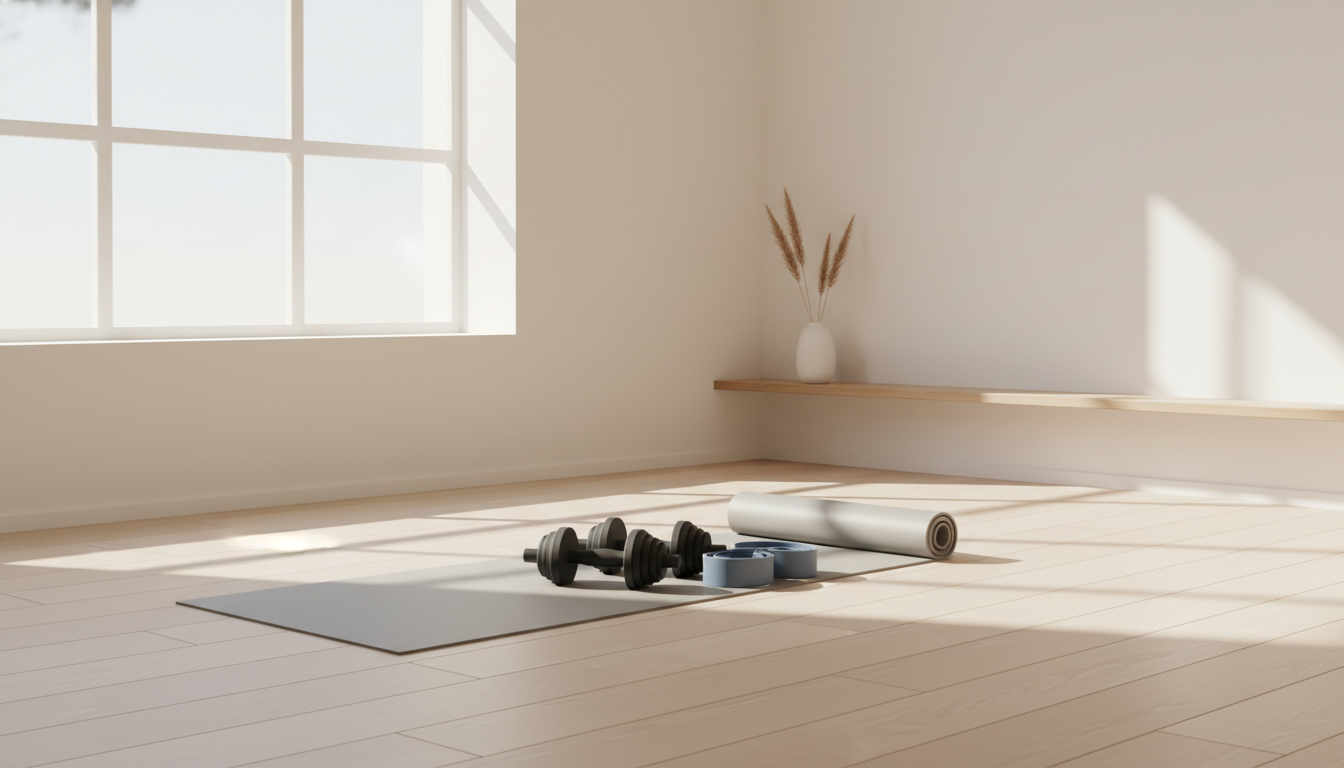
Starting a home gym is easy to overthink. You don’t need a full commercial setup—you need four or five pieces that cover the major movement patterns and don’t collect dust. Here’s what actually earns its floor space in a beginner setup.
The Single Best Starting Point: Adjustable Dumbbells
If you buy nothing else, buy a good pair of adjustable dumbbells. They cover pressing, rowing, hinging, curling, and carrying—essentially every movement a beginner needs to build a foundation.
The Bowflex SelectTech 552s are the most common recommendation for good reason: they adjust from 5 to 52.5 lb in small increments, the dial system is fast enough to not kill your momentum, and they’re widely available. If the price is a barrier, the PowerBlock Sport 24 covers 3–24 lb at a lower entry point and can be expanded later.
Avoid cheap twist-lock adjustables. The collars wear out, the weight range tops out too low, and you’ll replace them within a year.
A Barbell and Weight Plates (When You’re Ready to Invest)
Dumbbells plateau eventually. A barbell opens up squats, deadlifts, bench press, and rows at a scale that no pair of dumbbells can match long-term.
For a beginner barbell, you don’t need anything exotic. A Rogue Ohio Bar is the gold-standard recommendation, but it’s premium-priced. The Rep Fitness Gladiator Bar hits the same quality marks at a lower cost and is worth serious consideration. Either way, look for a 28–29mm shaft, a weight capacity above 1,000 lb, and decent knurling.
Pair it with rubber-coated bumper plates if your floor can’t take drops, or standard iron plates if you’re training on concrete. Buy in sets of 10s and 25s first—you’ll use them constantly.
A Power Rack or Squat Stand
A barbell is significantly less useful without somewhere safe to unrack it. A power rack also lets you bench press alone, set safety pins for heavy squats, and do pull-ups on the integrated bar.
Full cages (four uprights) are more stable and add storage options. The Titan T-3 and Rep PR-4000 are two of the most popular options in the $500–$900 range and have robust aftermarket accessories.
If ceiling height or budget is the constraint, a squat stand like the Rogue SML-2 gives you most of the functionality at half the footprint—just don’t train to failure on bench without a spotter.
An Adjustable Bench
A flat bench works, but adjustable is better. Incline pressing, seated dumbbell work, step-ups, Bulgarian split squats—a bench that adjusts from flat to 90 degrees handles all of it.
Look for stability first. A bench that rocks under a heavy dumbbell press is a liability. The REP AB-3000 and Flybird Adjustable Bench are both solid choices at different price points. Check the gap between incline settings—too few positions means you’ll often be stuck between the angle you want.
The bench is also the piece where budget options often fail fastest. The legs loosen, the padding compresses, or the adjustment mechanism sticks. Spend a bit more here than you think you need to.
Resistance Bands: Cheap, Effective, and Underrated
Bands aren’t a substitute for iron, but for a beginner they punch above their weight (literally). Use them for:
- Assisted pull-ups while building strength
- Hip activation work before lower body sessions
- Light face pulls and external rotation work for shoulder health
- Banded deadlifts and squats as a teaching tool for lockout
A set from Rogue or EliteFTS will last years. A cheap set from a no-name brand will snap mid-rep. Spend the extra $20.
Optional but High-Value: A Cardio Piece
Not everyone needs dedicated cardio equipment—walking outside is free and effective. But if weather, schedule, or preference makes that difficult, one piece of cardio equipment changes your consistency.
The Concept2 RowErg is the most commonly recommended first cardio buy because it’s full-body, low-impact, takes up minimal space when stored vertically, and the performance monitor is genuinely good for tracking progress. The AssaultBike Classic is a shorter session, higher intensity option that works well for conditioning finishers.
Treadmills are the most-returned home gym purchase. Unless you specifically need to run indoors, they take up too much space for too narrow a use case.
How to Sequence Your Purchases
You don’t need everything at once. A reasonable progression:
- Adjustable dumbbells — start here, train for 2–3 months
- Adjustable bench — adds exercise variety immediately
- Power rack + barbell + plates — when you’re ready to load heavier
- Bands and accessories — fill in gaps as you identify them
- Cardio equipment — only if you’ll actually use it
Bottom line: A $600–$800 investment in quality adjustable dumbbells and a bench will take a complete beginner further than most people expect. Add a rack and barbell when the movements are dialed in and the budget allows. Buy less, buy better, and train consistently before upgrading.